
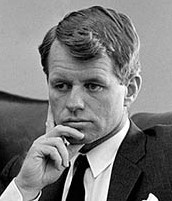
 June 8, 1968. Running for the Democratic nomination, Robert F. Kennedy was assassinated in the crowded “pantry” (actually, a food preparation area) of the Ambassador Hotel in Los Angeles after his primary election victory.1 His alleged killer, 24-year old Palestinian-American Sirhan Bishara Sirhan, never got close to Kennedy. He fired shots that hit five bystanders as Kennedy supporters struggled to subdue him; but none of his shots hit Kennedy. The fatal shot behind Kennedy’s ear came from just 1-3 inches away, according to Thomas Noguchi MD, who performed the autopsy.

On October 12, 1964, Mary Pinchot Meyer was murdered on the canal towpath in Georgetown1. A divorced artist from a prominent family, Meyer was known by insiders to have been President John F. Kennedy’s senior female consort during his White House years, though the story never leaked to the public.
Her murder and the ensuing trial of Raymond Crump, Jr., an African-American laborer found by the police in the vicinity of the murder, drew a good deal of attention at the time. Crump had been identified by a gas station attendant helping start a car on a road overlooking the canal. Hearing cries of “Somebody help me. Somebody help me” and two shots, the attendant ran to look.
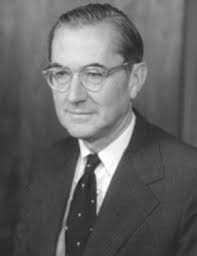 On April 27, 1996, 76-year old William Colby, former director of the CIA, disappeared from his vacation home on the water at Rocky Point, Maryland. Colby had spent the day at a marina fixing his sloop. He returned home after 6 pm, phoned his wife, who was visiting her mother in Texas, and told her he was tired and would eat supper, then go to bed. He watered his trees, met with his gardener and his visiting sister around 7:15 pm (sunset was at 7:57), and fixed himself a meal. The next day there was no sign of him. Eventually, a neighbor phoned the police. They found his supper half-eaten. The computer and radio were on. His canoe was missing.1
By the next day a full-scale search with helicopters and divers was under way.
 August 4, 1962. Celebrity actress Marilyn Monroe died in her bedroom in Los Angeles (or in the guest house near her house, from which she was carried back to her bedroom).1
 Sometimes a storyteller misses the real meaning of the story.
By all accounts, the Cuban Missile Crisis was the most dangerous episode of the Cold War. The United States and the Soviet Union came frighteningly close to launching nuclear attacks at each other. Only fear, luck, and occasionally inspired negotiating moved them onto the path of resolving the crisis−via a humiliating Soviet withdrawal in the face of U.S. nuclear superiority.
Historians have identified many motives for the initial Soviet decision to place missiles in Cuba.
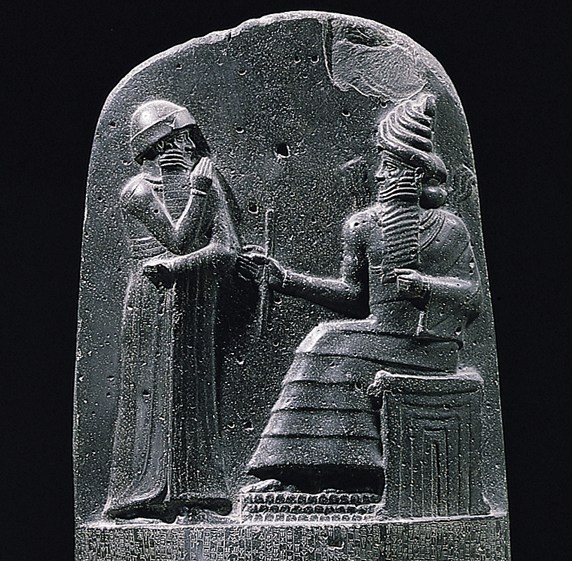 Atop the famous stele containing Hammurabi’s Code is a depiction of Hammurabi and Shamash, the Sun god, who was also the Babylonian god of justice. The swirling headdress of Shamash in this image might seem merely decorative, but in fact it possesses a dynamic meaning.
At the back of Shamash’s neck is an oval object that has no obvious purpose. It appears to be attached to the coiled shape of the headdress, as if it were the head of a serpent. But why would Shamash be wearing a serpent on his head?
To answer this question, one must become aware of the compelling new evidence for and reinterpretation of
Among the deepest mysteries of ancient Egypt 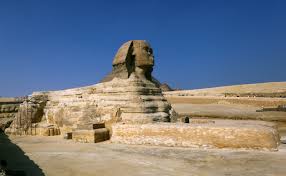 is the Great Sphinx of Giza. Researchers, both professional and amateur, have painstakingly investigated its every aspect.1 Yet key puzzles remain, above all the question of why this colossal structure, the ancient world’s largest monument, was built in the first place.
It’s not that serious researchers and free-ranging speculators have not proposed explanations. But every theory put forward falls well short of true persuasiveness or stumbles over inconvenient facts. Here are three anomalies a correct theory should explain.
 Karahunj (Zorats Karer) is an ancient site in southern Armenia that contains more than 230 large stones, some 37 still standing, arranged in a fashion that has suggested to many observers that it was used for archaeoastronomy. But defining how it was used has remained elusive. Complicating the situation, Karahunj is located near a complex of ancient graves; we do not know who built it; it is difficult to ascertain exactly when the stones were set up; and some 85 of them have holes drilled through them that researchers have suggested might be used for sighting celestial objects, but other researchers think this unlikely because they would have been too imprecise.1
Nonetheless, there is a rather simple explanation of the stones of Karahunj. But to grasp it, one must become aware of the compelling new evidence for and reinterpretation of
 New evidence and interpretation at the intersection of planetary science and religion can help us better understand the history of the Ancient Near East and of the origins of Islam.
A Revised Venus Theory corrects Immanuel Velikovsky’s original theory that the planet Venus first entered the inner solar system as a comet with a bifurcated tail around 1500 BC (new evidence indicates around 2525 BC). Now we have a much better explanation of the origin of Venus (rather than fissioning off of Jupiter, it was pulled from the outer solar system by Jupiter’s gravity and, via tidal heating, became a comet with a long tail). Venus interacted with the Earth on a 52-year cycle during the Late Bronze Age, causing catastrophes worldwide. And we now have a framework theory of the terrestrial planets into which these phenomena neatly fit and for which there is telling evidence. For Comet Venus, there is also newly interpreted, compelling iconographic and linguistic evidence. The names of both Athena (A Fena, the Phoenician) and Poseidon (Bos eidon, the Bull of Heaven), for instance, referred to the double-tailed Venus.
So with new-found confidence that the Ancients and Velikovsky were right about Venus, we can ask how can we use this to decipher aspects of the culture of the Ancient Near East and of the background of Islam.
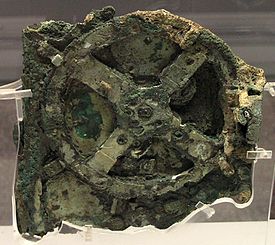
Decades of meticulous investigation have revealed many features of the 1st Century BC Antikythera Mechanism, a portable planetarium that demonstrated the motion of celestial objects. But we must question researchers’ conclusion that the Mechanism incorrectly represented the orbit of Mars, in particular, by roughly 30 degrees during retrograde motion1.
This discrepancy seems anomalous in a sophisticated device that otherwise exhibited a much smaller range of error. So maybe there is some other explanation.
 Many Germans have earnestly sought to overcome the Nazi past by publicizing its depredations, by acknowledging wrongdoing, by seeking restitution of stolen property, and by maintaining a respectful, responsive stance toward Jews in general and Israel in particular. Still, such is the burden of the Holocaust that another approach may also prove attractive to certain Germans. It involves Yiddish.
While Yiddish contains elements of Hebrew and Slavic languages, it is mainly an old dialect of German. A German speaker can understand most of it, and in fact Yiddish forms part of the study of German linguistics and literature, correctly understood. This means that a simple initiative could help bring Germans and Jews closer.
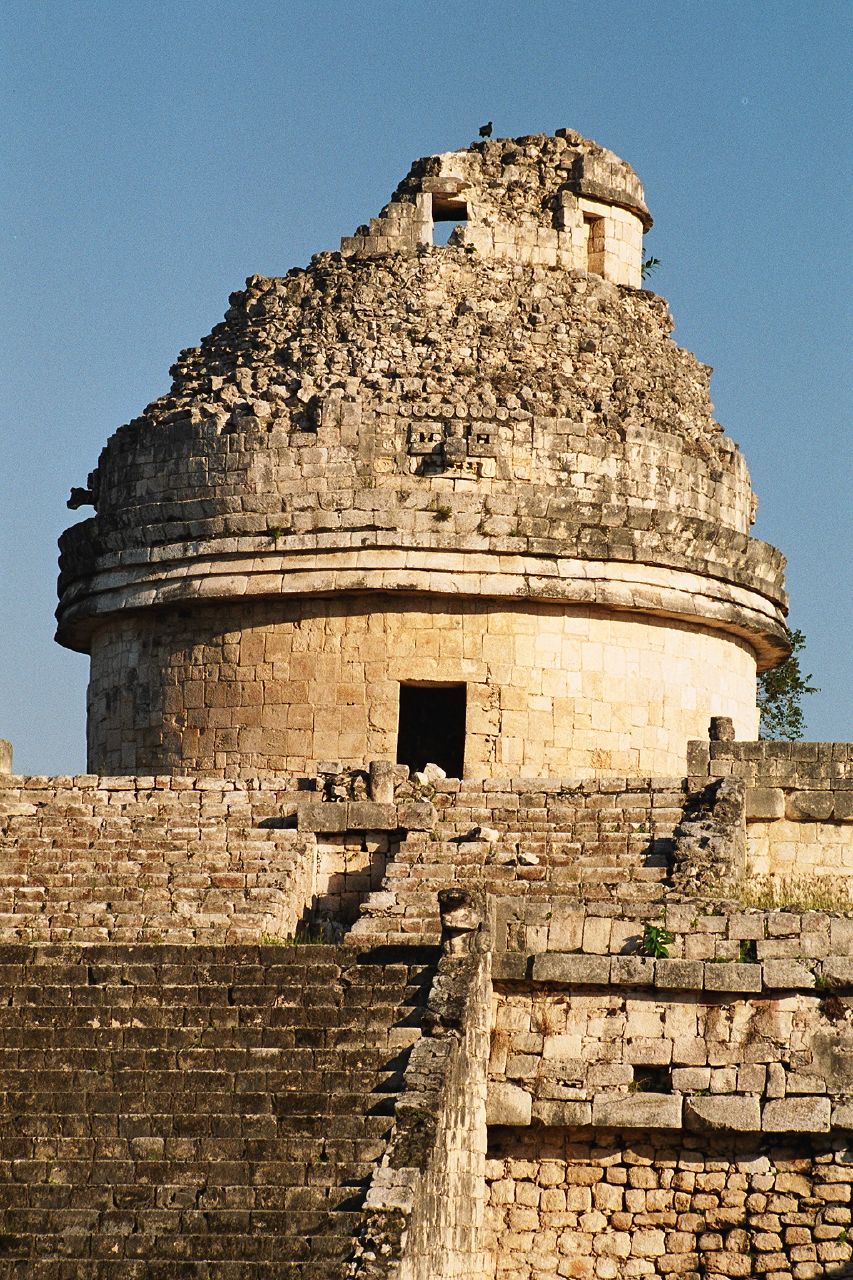 The civilizations of Mesoamerica abounded in mysteries. What caused their fixation on Venus? What led them to develop their intricate, highly precise calendars? What can explain the little pecked-cross circles embedded in the landscape? Why were these peoples so keenly bent on human sacrifice? What were the Aztecs referring to when they said that this was the age of the Fifth Sun?
We have a skeleton key that can unlock these old secrets.